An agent that sits in on sales calls and keeps the CRM current. I designed how it writes the small things itself with the audio behind every field, and holds back the one update a person has to hear for themselves.
- Role
- Product design, end to end (solo)
- Year
- 2026
- Platform
- Live call, web, phone
- Domain
- Sales operations · Forecasting
- Delivered
- Agent behaviour, voice UI, screens, coded prototype, recordings
- Built on
- Prodular UI, plus a voice layer built for this
A sales forecast is assembled on a Friday afternoon from memory. Reps update the CRM from what they recall of calls they had on Tuesday, and a revenue leader presents the total to a board on Monday morning as though it were measured.
Sotto is the product I designed to close that gap. The scenario follows Copperline, a dock scheduling company: six reps, 46 calls in a week, 128 updates the agent proposes from what was actually said, and one of them held back because two people spoke at once.
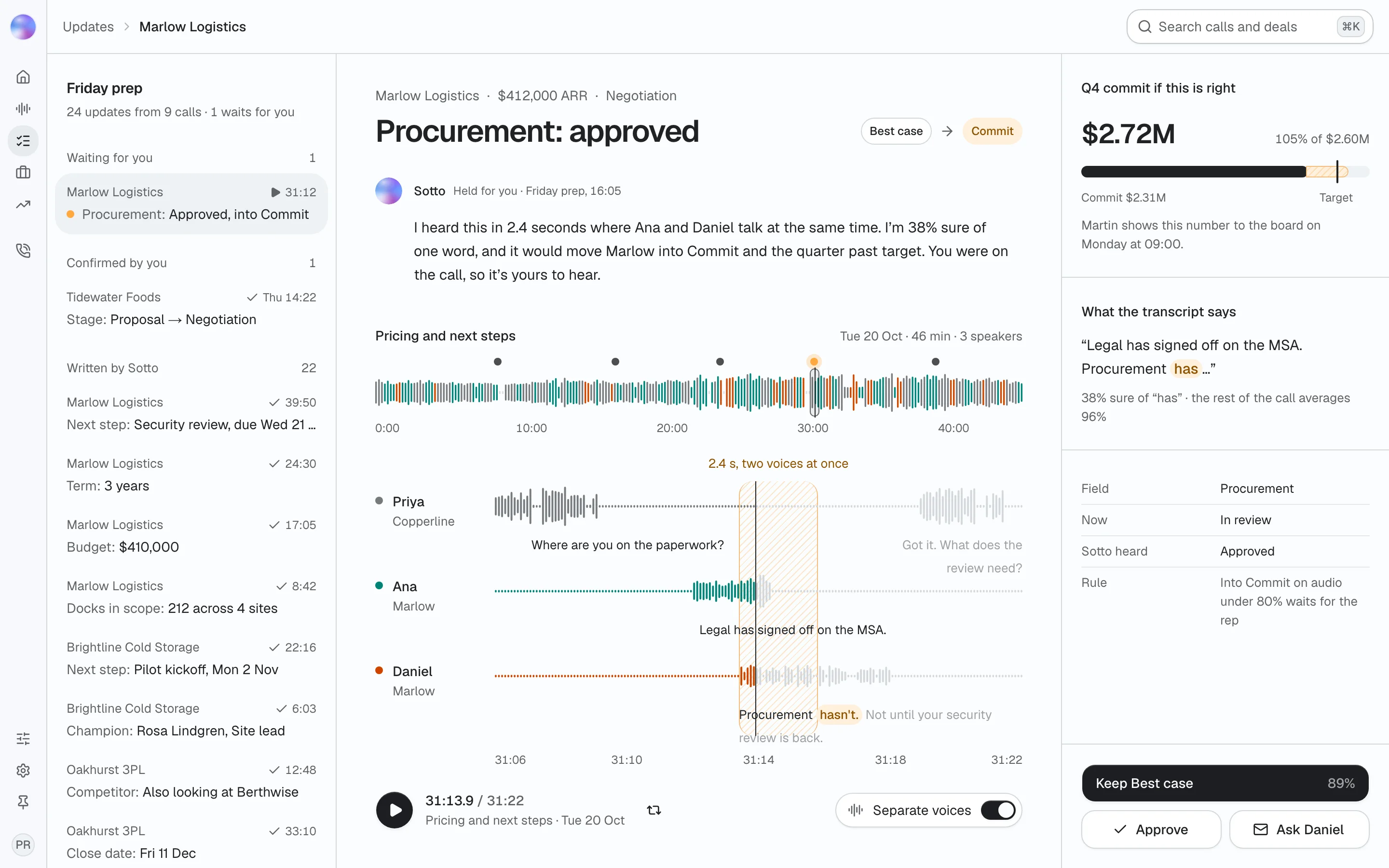
The call, as it happens
Fields fill in while the rep is still talking, each one landing with the seconds it was heard in. Nothing is written silently, and nothing waits for a Friday.
An agent that fills in the CRM is only useful if you can check it without listening to the call.
Transcription is solved. Judgement is not. The moment an agent writes a field that moves a forecast, somebody has to be able to see where that came from, and the cost of being wrong is not a typo in a database. It is a number shown to a board.
- 01
Fields with no provenance
A budget appears in the CRM and nobody can say whether the buyer said it, the rep assumed it, or the model inferred it from something adjacent.
- 02
Crosstalk at exactly the wrong moment
Two people talk over each other for two seconds, and one of those seconds contains the word that decides whether a deal is committed.
- 03
Everything or nothing
An agent that asks permission for all 128 updates is worse than no agent. One that writes all of them without asking will eventually write the wrong one into the board deck.
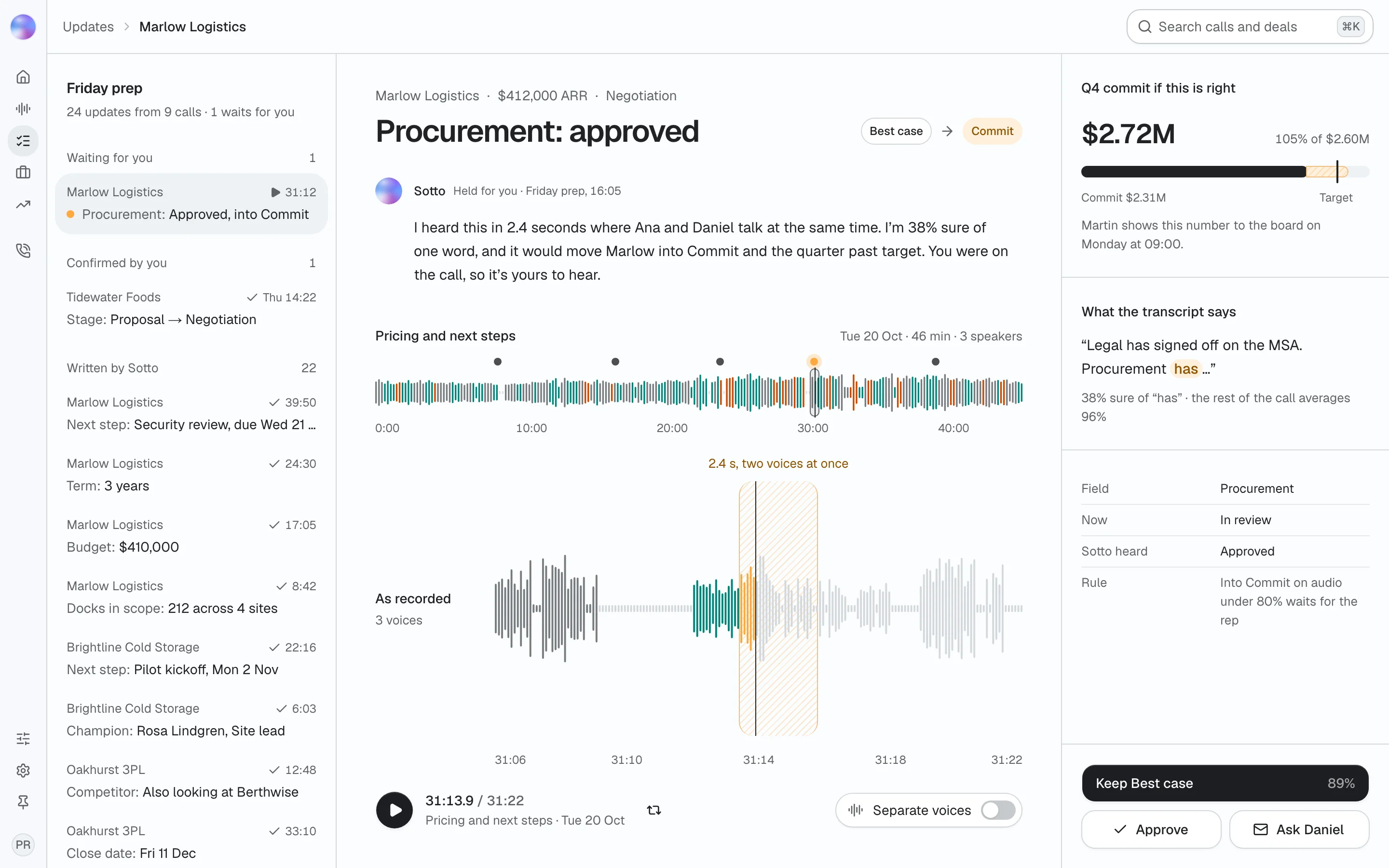
The week, and the one thing held back
A hundred and twenty-one updates written on their own, each with its clip. One waiting, because the audio behind it would move a deal into commit and the agent was not sure enough of a single word.
Make the evidence the interface, not an attachment to it.
The idea that decides this product is knowing which updates a person must hear. Everything on screen exists to make that line visible and to make the evidence one tap away.
- 01
Defined the confidence rule that separates what the agent writes on its own from what it holds for a human, and tied it to forecast impact rather than to a flat threshold.
- 02
Designed the three surfaces: the live call, the week in review on the web, and the revenue leader's phone.
- 03
Designed a voice interface language from scratch: presence, waveforms coloured by speaker, a clip player that splits one recording into a lane per voice, and captions that arrive word by word.
- 04
Built the working prototype, including the audio components, so the timing of a live call could be felt rather than storyboarded.
Start from the one update that matters
I designed the held update first, the six seconds of crosstalk, and worked outward. If that moment is not convincing, the other 127 updates are not worth automating.
Attach the audio to the field, not to the call
A link to a 46-minute recording is not evidence. The clip that plays the seconds where somebody said it is, and it fits inside a table row.
Separate the voices visually
When two people speak at once, the product pulls one recording into a lane per speaker so the disputed word sits in one person's line. That is a design answer to an audio problem.
Let the leader ask out loud
The phone surface answers a spoken question with the clip behind it, because the alternative is a revenue leader opening the CRM and trusting it silently.
The leader asks out loud
Before a board call he asks why a deal is not committed. The answer plays the buyer saying procurement has not approved, and the clip where legal signed off, then he sends the forecast.
Four decisions did most of the work.
- 01
Every field carries the clip it came from
Budget, term, next step: each one plays the seconds where somebody said it. The cost is that if nobody said it out loud, the agent does not write it and the rep types it in. I preferred a gap I can see to a guess I cannot.
- 02
The agent writes the small things and holds what moves the forecast
Next steps, contacts and dates go straight in. A deal moving into commit on audio the agent is less than four fifths sure of waits for a person. The cost is that a rep still listens to a clip on a Friday afternoon.
- 03
The person who was on the call decides
Not revenue operations, not the leader. The rep was there, so the clip goes to her with the voices pulled apart. The cost is that the forecast waits for one specific person rather than whoever is free.
- 04
Confidence is shown as a number and a sound
The agent states how sure it is of a single word, and lets you hear the moment it is unsure about. A percentage on its own invites people to argue with the model instead of listening to the evidence.
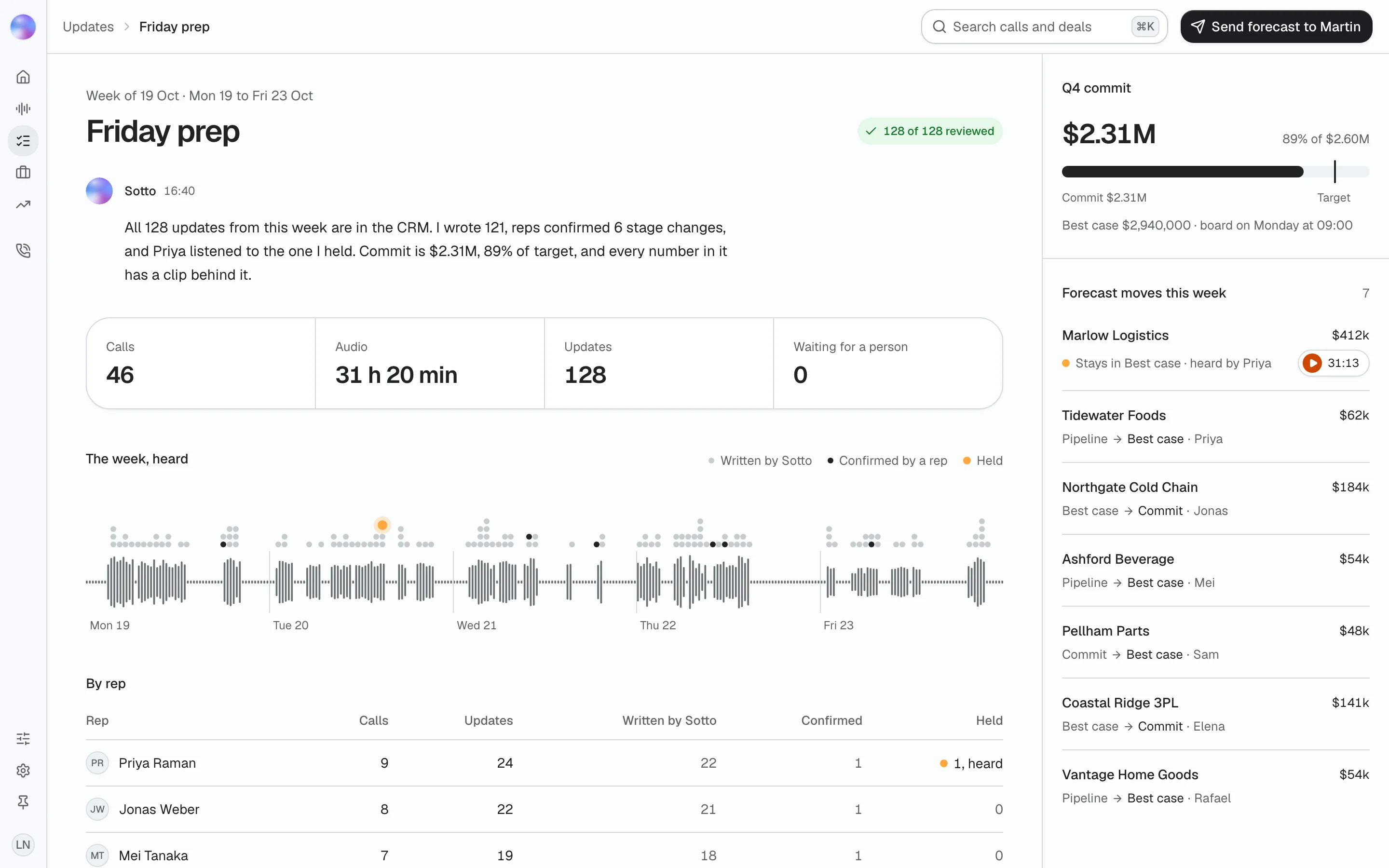
A forecast that can be traced
Every line the leader shows on Monday resolves to a moment on a call. That is the whole claim of the product, and it is the only screen where it can be checked at a glance.
A CRM that can play its own sources, and an agent that knows when to stop.
The result is a week that ends with a forecast nobody had to reconstruct from memory: written as it was said, evidenced clip by clip, and held at the one point where a human ear was worth more than a model's confidence.
It demonstrates a voice interface language built from scratch, an agent whose restraint is designed rather than configured, and audio components built in code so a live call could be judged on timing instead of described in a storyboard.
- 128
- updates proposed from what was said on 46 calls
- 121
- written automatically, each carrying its clip
- 1
- held for a person, on 2.4 seconds of crosstalk
- 3
- surfaces sharing one evidence model: call, web and phone
If I took this further, the next step would be a real sales floor for a full quarter. Whether a rep keeps trusting 121 automatic updates, and whether separating the voices settles a disputed word faster than reading a transcript, are the two assumptions carrying the most weight.
Wake
Dispatch that shows its knock-on