An AI agent for in-house legal teams. I designed how it reads the customer's paper against the playbook, redlines it in language legal already approved, and cites a clause for every change it proposes.
- Role
- Product design, end to end (solo)
- Year
- 2026
- Platform
- Legal web, CFO phone, sales chat
- Domain
- Legal operations · Contract review
- Delivered
- Agent behaviour, IA, screens, coded prototype, recordings
- Built on
- Prodular UI, my own design system
In-house legal is usually one or two people holding the line on every contract a sales team sends out. The work is not reading speed. It is knowing which of two hundred clauses quietly undoes another one, and being able to prove it to a CFO who has to sign the exception.
Brace is the product I designed for that team. The scenario follows Fernway, a scheduling software company whose largest deal of the year arrives on a Friday night as the customer's own contract: 52 pages, 214 clauses, a quarter that closes on Wednesday, and one lawyer.
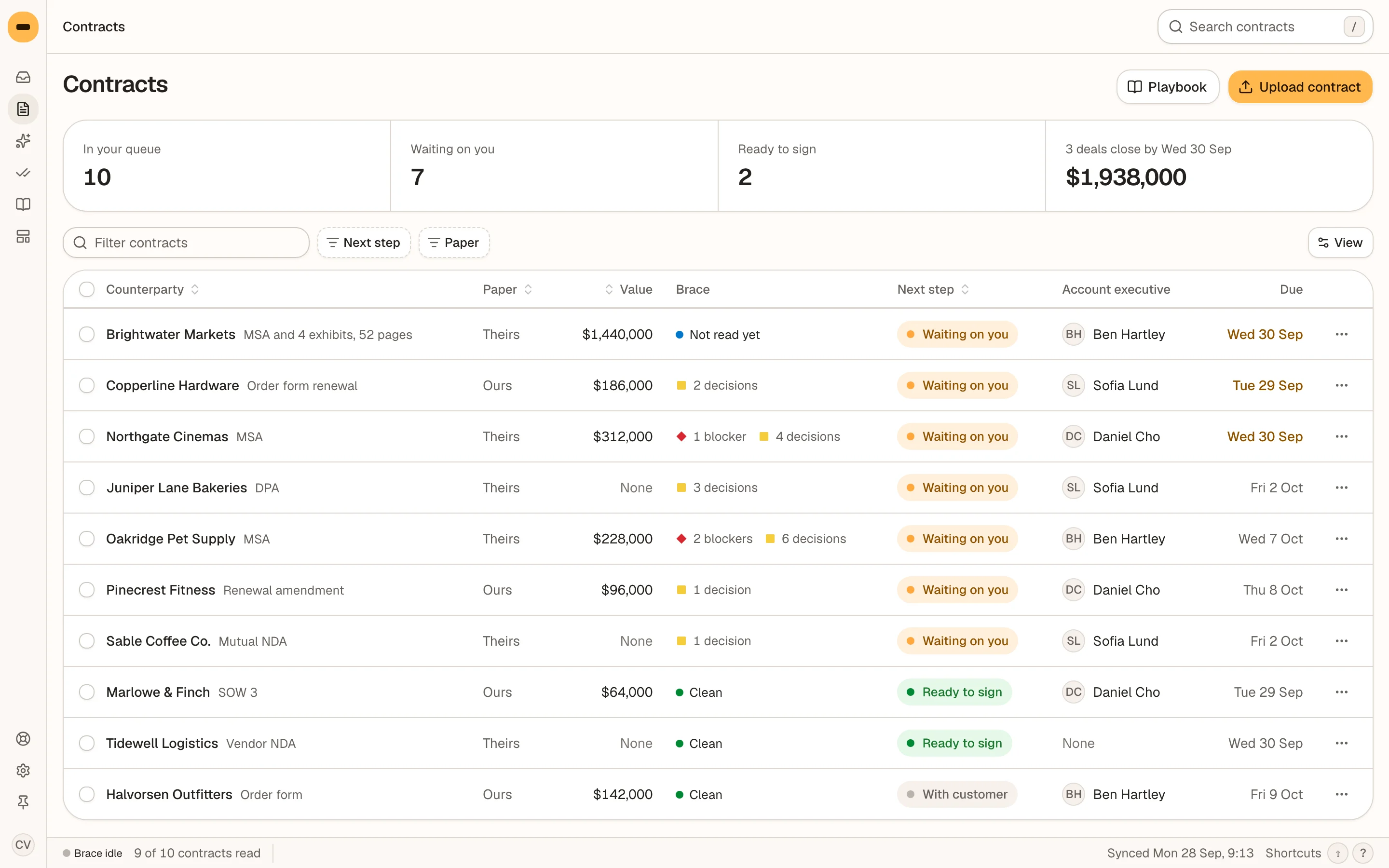
Monday, ten contracts deep
The queue leads with what has not been read and what is blocked, not with everything that exists. A lawyer opens the product already knowing where the day goes.
An AI that reads a contract is easy to build and almost impossible to trust.
A lawyer cannot act on a summary. If the model says the liability cap has been removed, the only useful answer is which clause removed it, on which page, and what the playbook allows instead. Anything less and the lawyer rereads all 52 pages anyway, which is the work the product was supposed to save.
- 01
The contradiction hides across pages
A cap in section 12 and an exhibit 24 pages later that sets it aside. Each clause reads as reasonable alone, and nothing in a document viewer connects them.
- 02
Answers without sources
A confident paragraph from a model is worth less than one sentence with a clause number behind it, because only one of the two can be checked.
- 03
The exception waits for a person who is not in the document
The lawyer can draft the counter in minutes. Getting the CFO to approve it takes days of email, because the decision travels without the clause it depends on.
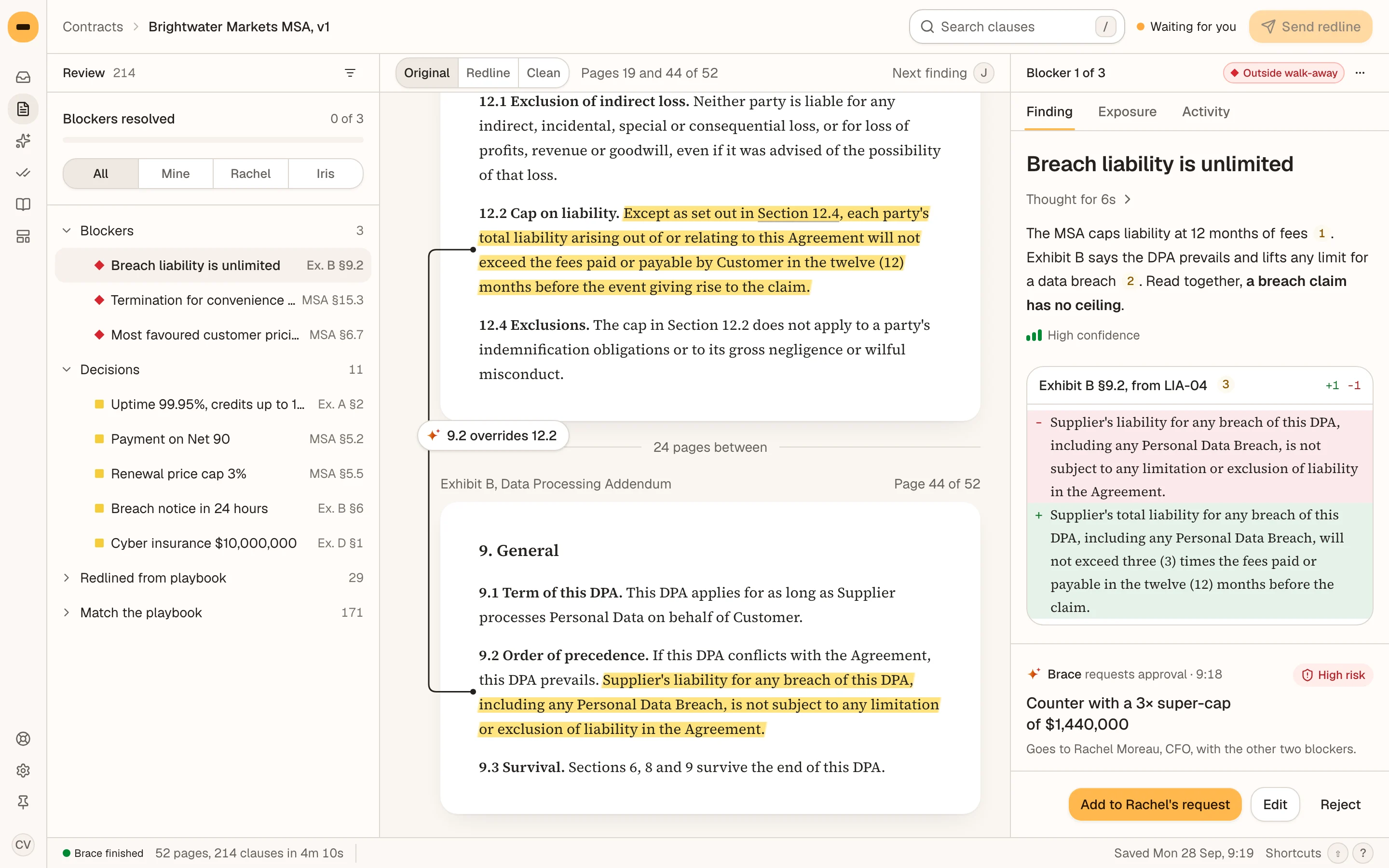
The bracket across 24 pages
Section 12.2 caps liability at a year of fees. Twenty-four pages later an exhibit says it prevails and that a breach has no limit at all. The product draws the connection in the document, highlighted where the contract says it.
Start from what a lawyer has to be able to prove.
The hard part of this one was not the interface. It was writing the rules that decide when the agent acts, when it asks, and when it refuses, then designing screens that make those rules visible.
- 01
Defined the agent's operating rules: what it may redline on its own, what it must escalate, and what it must refuse to answer.
- 02
Designed the three surfaces the decision travels through: the lawyer's review, the CFO's phone approval and the sales chat.
- 03
Designed the provenance model, so every claim resolves to a clause and every redline to a playbook position.
- 04
Built the working prototype and recorded the flows, so the timing of a four-minute read could be judged rather than described.
Write the refusal rules first
Before any screen, I wrote down what the agent must never do: no new clause language, no claim without a citation, no guess where a document is missing. Those three rules shaped everything after them.
Model the playbook as the source of truth
Every redline is a fallback a lawyer already approved, held as a numbered position. That turns the agent from an author into something closer to a very fast paralegal with a rulebook.
Design the cross-reference as an object
The bracket joining two clauses 24 pages apart is the product's central idea, so it is drawn in the document itself rather than described in a side panel.
Follow the decision off the lawyer's screen
An exception is not resolved until the person who owns it has approved it. I designed the CFO's phone view with the clause on it, because approving a number without its source is the thing that takes two days.
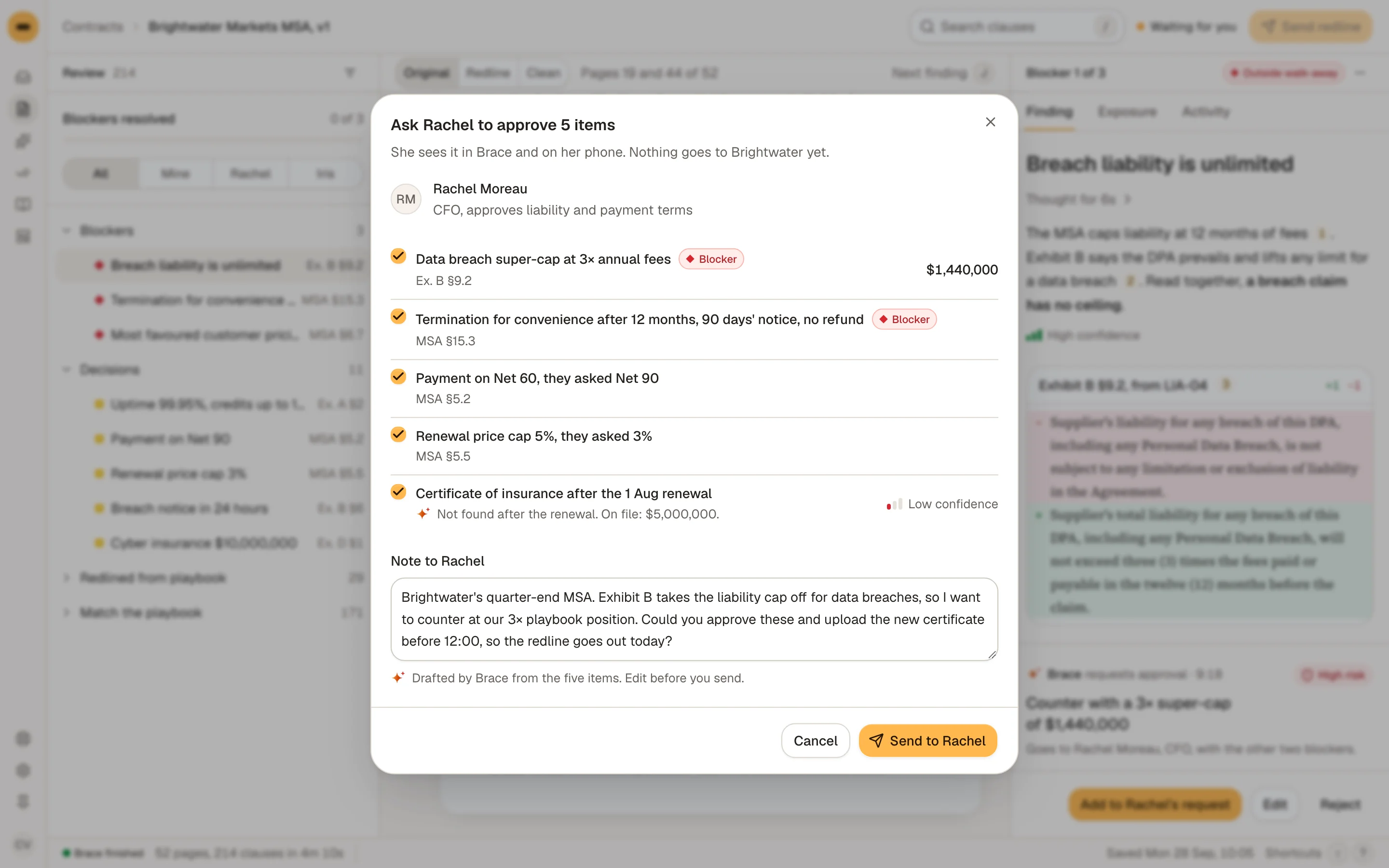
Five exceptions, one request
Each exception carries the clause it came from, the playbook position it breaks and the point at which the company would walk away. The CFO approves once rather than five times.
Four decisions did most of the work.
- 01
The agent proposes, a person commits
Nothing reaches the customer until legal sends it, and every exception goes to the person who owns it. The cost is real: the agent can be four minutes from a redline that then waits an hour for a CFO. I took it because the alternative is a product no legal team would turn on.
- 02
Only the playbook's language, never new clause text
When the playbook has no answer, the agent says so and stops instead of drafting one. The cost is that it goes quiet on exactly the novel clauses a lawyer finds hardest, which is also where a wrong draft would do the most damage.
- 03
Every claim cites a clause, and says when it cannot
An answer without a source is not shown, and a missing document becomes a question rather than an assumption. The cost is more questions back to finance in the first week of a contract.
- 04
One request, not five emails
Exceptions are batched into a single approval with the clause, the playbook position and the walk-away beside each one, so the CFO decides once with everything in front of her.
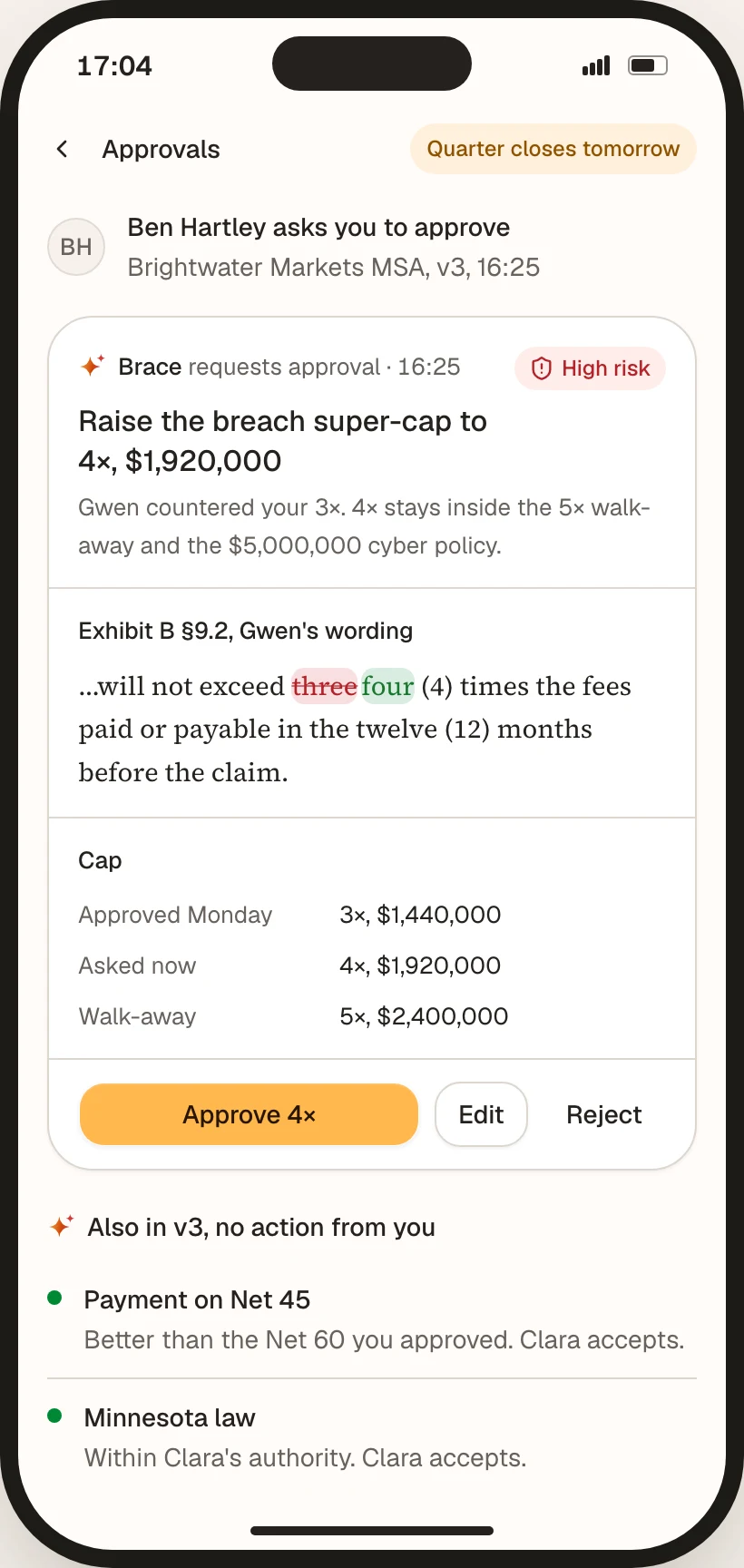
Approved from a phone, with the clause on it
The decision that used to take two days of email happens on a phone in under two hours, because the number arrives with the wording and the limit attached.
Sales asks in plain words
A salesperson asks whether it can still sign tomorrow. The answer comes back with the three open counters, the clause behind each and the name of the person who decides, which is the thing that stops the next interruption to legal.
An agent fast enough to matter and auditable enough to be allowed near a contract.
The result is one continuous week: a contract read against the playbook in four minutes, a cross-reference no one would have caught by page 44, a batched approval decided from a phone, and a redline out the same day it arrived.
It demonstrates agent behaviour designed as product rules with their costs written down, a provenance model carried consistently across three surfaces, and dense document UI built in code so the reading experience could be judged at real density.
- 214
- clauses sorted into match, redline, decide and blocker
- 4
- minutes from opening the file to the first finding
- 2
- citations behind the finding that the liability cap had been removed
- 0
- lines of new clause text; every redline came from the playbook
If I took this further, the next step would be putting the bracket in front of in-house lawyers with real contracts. Whether someone trusts a cross-reference they did not find themselves, and whether a CFO will approve a seven-figure cap from a phone, are the two assumptions carrying the most weight.
Holdout
The conversations an average hides